Texas Instruments INA240-Q1 Handleiding
Texas Instruments Niet gecategoriseerd INA240-Q1
Bekijk gratis de handleiding van Texas Instruments INA240-Q1 (38 pagina’s), behorend tot de categorie Niet gecategoriseerd. Deze gids werd als nuttig beoordeeld door 4 mensen en kreeg gemiddeld 4.0 sterren uit 8 reviews. Heb je een vraag over Texas Instruments INA240-Q1 of wil je andere gebruikers van dit product iets vragen? Stel een vraag
Pagina 1/38
INA240-Q1 AEC-Q100, –4-V to 80-V, Bidirectional, Ultra-Precise Current Sense
Amplifier With Enhanced PWM Rejection
1 Features
•AEC-Q100 Qualified for Automotive Applications
–Temperature Grade 1: –40°C to +125°C
Ambient Operating Temperature Range
–Temperature Grade 0: –40°C to +150°C
Ambient Operating Temperature Range
–HBM ESD Classification Level H2
–CDM ESD Classification Level C5
•Functional Safety-Capable
–Documentation available to aid functional safety
system design
•Enhanced PWM Rejection
•Excellent CMRR:
–132-dB DC CMRR
–93-dB AC CMRR at 50 kHz
•Wide Common-Mode Range: –4 V to 80 V
•Accuracy:
–Gain Error: 0.20% (Maximum) With 2.5 ppm/°C
(Maximum Drift)
–Offset Voltage: ±25 μV (Maximum) With 250
nV/°C (Maximum Drift)
•Available Gains:
–INA240A1-Q1: 20 V/V
–INA240A2-Q1: 50 V/V
–INA240A3-Q1: 100 V/V
–INA240A4-Q1: 200 V/V
2 Applications
•Electronic Power Steering
•Stability and Traction Control
•Motor and Actuator Control
•Solenoid and Valve Control
SPACER
+
Supply
(2.7V to 5.5V)
IN+
IN-
REF1
REF2
OUT
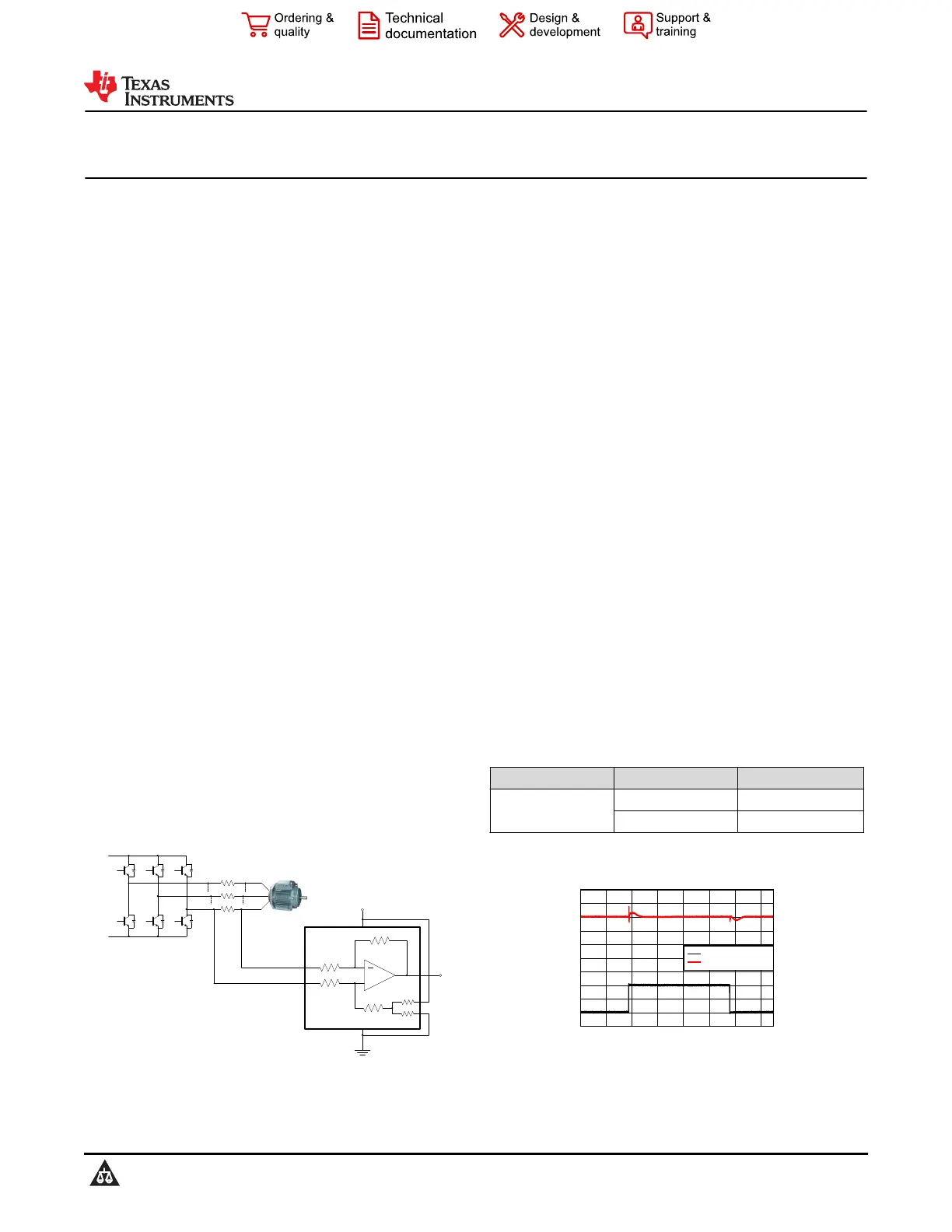
Typical Application
3 Description
The INA240-Q1 device is an automotive-qualified,
voltage-output, current-sense amplifier with enhanced
PWM rejection that can sense drops across shunt
resistors over a wide common-mode voltage range
from –4 V to 80 V, independent of the supply
voltage. The negative common-mode voltage allows
the device to operate below ground, accommodating
the flyback period of typical solenoid applications.
Enhanced PWM rejection provides high levels
of suppression for large common-mode transients
(ΔV/Δt) in systems that use pulse width modulation
(PWM) signals (such as motor drives and solenoid
control systems). This feature allows for accurate
current measurements without large transients and
associated recovery ripple on the output voltage.
This device operates from a single 2.7-V to 5.5-V
power supply, drawing a maximum of 2.4 mA of
supply current. Four fixed gains are available: 20
V/V, 50 V/V, 100 V/V, and 200 V/V. The low offset
of the zero-drift architecture enables current sensing
with maximum drops across the shunt as low as 10-
mV full-scale. Grade 1 versions are specified over
the extended operating temperature range (–40°C to
+125°C) and are offered in an 8-pin TSSOP and 8-pin
SOIC packages. Grade 0 versions are specified over
the extended operating temperature range (–40°C to
+150°C) and are offered in an 8-pin SOIC package.
Device Information
(1)
PART NUMBERPACKAGEBODY SIZE (NOM)
INA240-Q1
TSSOP (8)3.00 mm × 4.40 mm
SOIC (8)4.90 mm × 3.91 mm
(1)For all available packages, see the package option
addendum at the end of the data sheet.
Time (2 µs/div)
Common-Mode StepDDDDDDDDDDDDD
DDDDDDDDDDDDD
INA240 Output
-30-1.5
0-1
30-0.5
600
900.5
1201
1501.5
1802
2102.5
2403
2703.5
D004
270
Y1
240
210
180
150
3.50
Y1
3
2.5
2
1.5
Common-Mode Step
INA240 OUT
Enhanced PWM Rejection
INA240-Q1
SBOS808E – AUGUST 2016 – REVISED DECEMBER 2021
An IMPORTANT NOTICE at the end of this data sheet addresses availability, warranty, changes, use in safety-critical applications,
intellectual property matters and other important disclaimers. PRODUCTION DATA.
Product specificaties
| Merk: | Texas Instruments |
| Categorie: | Niet gecategoriseerd |
| Model: | INA240-Q1 |
Heb je hulp nodig?
Als je hulp nodig hebt met Texas Instruments INA240-Q1 stel dan hieronder een vraag en andere gebruikers zullen je antwoorden
Handleiding Niet gecategoriseerd Texas Instruments

16 Augustus 2026
10 Augustus 2026
7 Augustus 2026
6 Augustus 2026
6 Augustus 2026
6 Augustus 2026
6 Augustus 2026
5 Augustus 2026
5 Augustus 2026
4 Augustus 2026
Handleiding Niet gecategoriseerd
Nieuwste handleidingen voor Niet gecategoriseerd
26 Augustus 2026
26 Augustus 2026
26 Augustus 2026
26 Augustus 2026
26 Augustus 2026
26 Augustus 2026
26 Augustus 2026
26 Augustus 2026
26 Augustus 2026
26 Augustus 2026